From Guitar Delay Pedal Concept to Tunable Audio Gating System
Overview
This project began as an attempt to design an analog delay and echo pedal for guitar, inspired by common audio effects such as delay, reverb, and echo. Through experimentation with passive and active low-pass filters, we initially believed we had achieved signal delay. However, further analysis revealed that what we had created was primarily phase shift, which, when combined with the original signal, resulted in signal cancellation rather than true time delay.
Instead of abandoning the concept, I identified that the underlying RC behavior of the circuit could be repurposed into something more physically meaningful: a tunable time-delay control circuit. The project pivoted into the development of an adjustable analog timer capable of gating audio on or off after a controlled delay period.
Technical Evolution
Initial Approach: Audio Delay via Filtering
Research focused on:
- How delay is created in analog circuits
- Cascading passive low-pass filters
- Active low-pass filter configurations
While phase shift is technically a form of delay, combining the shifted signal with the original caused partial cancellation — effectively producing a form of unintended noise cancellation rather than echo.
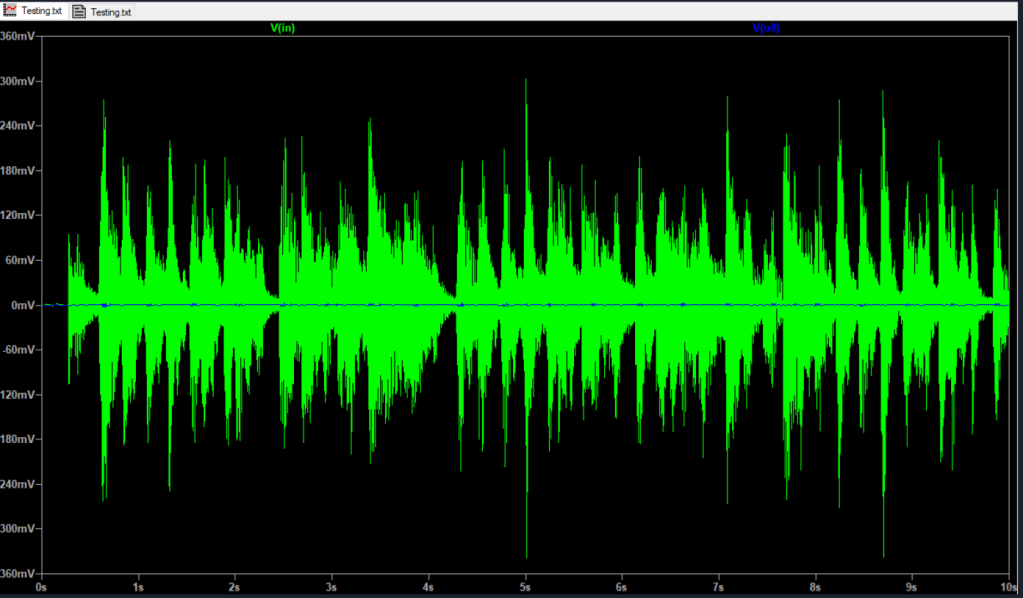
This was a key learning moment: phase delay ≠ time delay.
Design Pivot: RC Timer-Based Audio Control
Recognizing that a passive low-pass filter is fundamentally an RC timing circuit, I redesigned the system into a functional timer-controlled filter.
Final Circuit Architecture
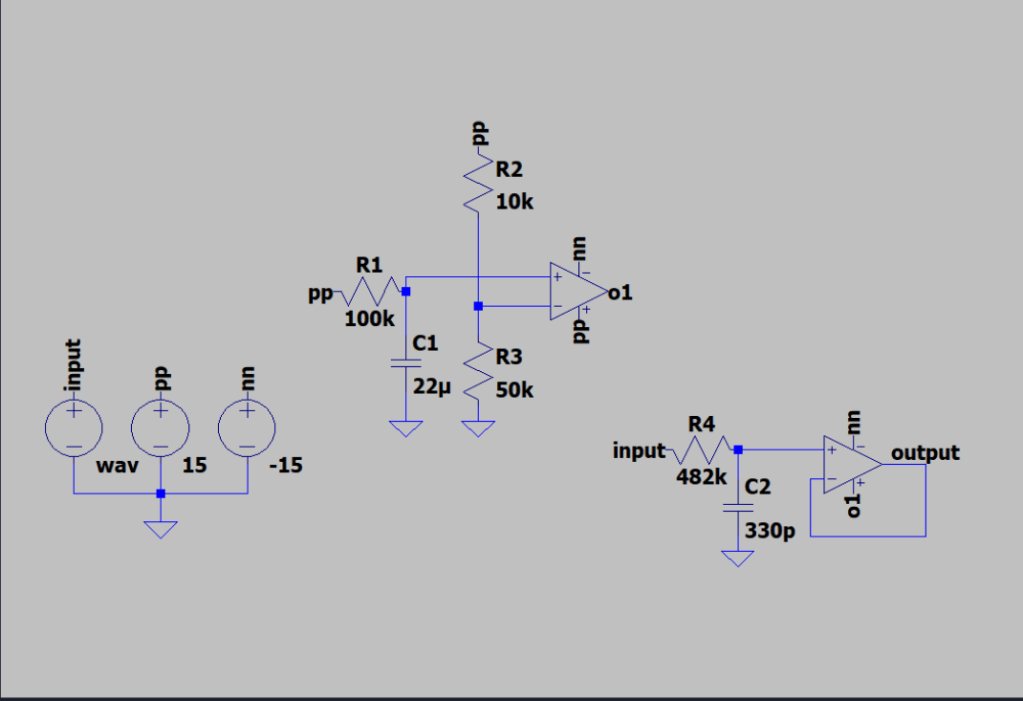
As shown in the redesigned schematic:
- R1 × C1 sets the maximum delay time
- A potentiometer allows the user to tune the delay interval
- R2 & R3 form a voltage divider
- A comparator determines when the RC threshold is reached
- R4 and C2 implement a low-pass filter (~1 kHz cutoff)
- The output is gated after the time threshold
This created a physically tunable delay mechanism, allowing the user to:
- Turn audio on after a selected delay
- Kill audio after a selected delay
- Dynamically adjust timing with a potentiometer
Results
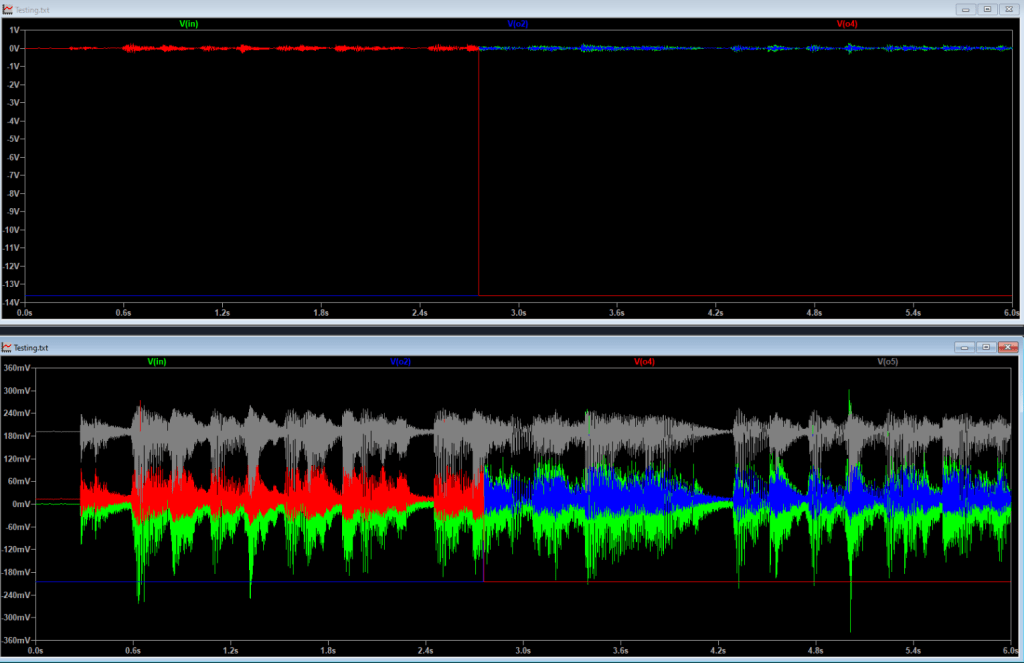
Simulation results showed:
- Clear separation between input (green) and delayed output (blue) signals
- Successful timed activation of the output
- Demonstrated delayed filtering behavior
While hardware limitations introduced a DC offset, the functional behavior of the timer-based audio gating system was validated.
 Carter Trudeau